Subscribe
Login
0 Comments
Oldest
A reusable pad may look like a simple product. Follow what happens after it leaves our production space, and what your organisation’s procurement can set in motion.
A reusable sanitary pad may look like a simple product. For the woman or girl who needs it, however, it can represent something much bigger: a practical response to the recurring cost of menstrual care, an opportunity to manage menstruation with greater confidence, and a step towards reducing the waste associated with disposable menstrual products.
For an organisation investing in menstrual health, the question goes even further.
What happens after the product is purchased?
At Caryle Enterprises, we believe that meaningful menstrual health programmes should consider the entire journey of a product, from production to the person it is intended to serve. That is the journey behind DignifyHer™ Reusable Menstrual Health Solutions.
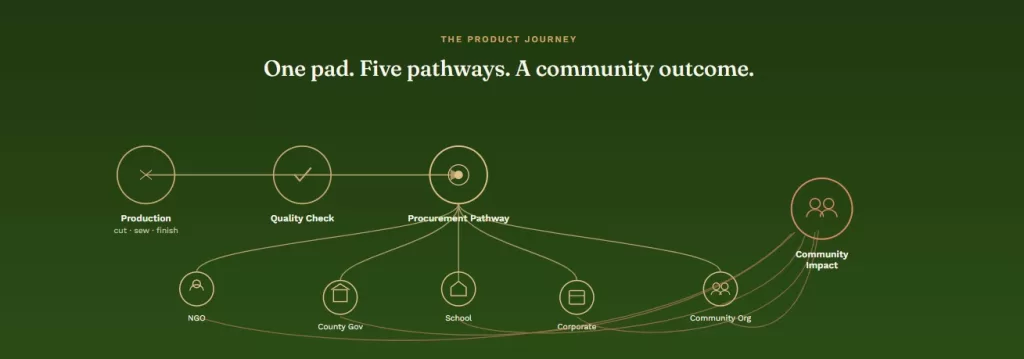
Every DignifyHer™ pad begins as a product that must be designed and produced with purpose. Our focus is on creating reusable menstrual health solutions that are practical, durable and accessible to the communities we serve. Production involves careful cutting, sewing, finishing and quality checking before products are prepared for delivery.
Quality matters because a menstrual health product is not an ordinary consumer item. It is something a girl or woman relies on during an important part of her monthly life. For institutional and bulk buyers, quality also matters because every procurement represents an investment in the wellbeing of the people a programme serves.
Once the products have passed our quality checks, they can move into different distribution pathways depending on the partnership. The product is the same, the pathway to impact can be very different.
NGO
Procures DignifyHer™ kits for a menstrual health programme.
County Government
Integrates reusable products into a broader girls’ education or public health initiative.
School
Works with Caryle to provide menstrual health solutions alongside education and awareness.
Corporate
Purchases products as part of its ESG or social investment programme.
Community Organisation
Uses a group-based financing model to make products more accessible to families.
This is where procurement becomes more than a transaction. Supplying 500 or 1,000 reusable pads is important, but the real question is what that supply enables.
What the supply should enable
? Can more girls manage their periods without the recurring pressure of purchasing disposable products every month?
? Can a school create a more supportive environment for girls?
? Can a community organisation develop a sustainable way of helping families access menstrual products?
? Can an NGO demonstrate measurable outcomes to its funders?
? Can a corporate connect its ESG investment to tangible social and environmental outcomes?
These are the questions that should shape menstrual health partnerships.
At Caryle, we are increasingly interested in the relationship between products, skills and local capacity. This is why our work extends beyond DignifyHer™ through CircularSkills™, our practical training division. Through CircularSkills™, women and youth can acquire practical skills in reusable sanitary pad production and other areas of sustainable manufacturing.
A community that receives products has immediate access to a solution. A community that also develops the capacity to produce solutions has an opportunity to build longer term resilience and economic opportunity.
Our recent CircularSkills™ training for women from Badilisha CBO reinforced this belief. The participants discovered Caryle through an online search and our digital content before engaging us for practical training in reusable sanitary pad production.
That journey was significant to us. It demonstrated that digital visibility can connect a local Kenyan enterprise with communities looking for practical solutions, while skills development can transform a simple training engagement into a pathway towards local capacity building.
For NGOs and development partners, sustainable menstrual health requires more than distributing products. It requires thoughtful programme design, appropriate products, community engagement, education, measurable outcomes and consideration of what happens after programme funding ends.
For corporates, the opportunity is equally significant. Menstrual health can form part of a broader ESG agenda that connects gender equality, education, health, economic inclusion and environmental responsibility. Rather than treating menstrual health as a standalone charitable activity, organisations can develop partnerships that generate measurable value across several areas.
A DignifyHer™ procurement programme can therefore contribute to:
The precise outcomes will depend on the design, scale and implementation of each partnership.
We believe the strongest institutional relationships begin with a conversation.
→ Perhaps your organisation needs 200 kits for a community programme.
→ Perhaps you are planning a countywide menstrual health initiative.
→ Perhaps your school network requires a reliable supplier.
→ Perhaps your corporate ESG programme wants to support girls while strengthening environmental outcomes.
→ Perhaps you are looking for a programme that combines menstrual health products with practical skills development for women and youth.
Each requires a different approach. Caryle can work with organisations to explore the appropriate product quantities, pricing, distribution model, training requirements and impact objectives.
The journey of a DignifyHer™ pad does not end when it leaves
our production space. It ends where it creates value for a girl,
a woman, a family, a school or a community.
And when designed well, that journey can create value far beyond the individual product.