Subscribe
Login
0 Comments
Oldest
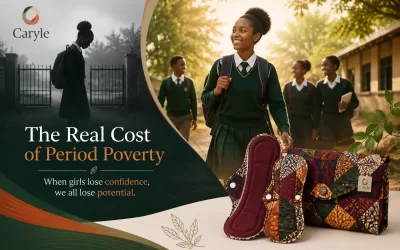
Yet for thousands of girls across Kenya, one week every month brings a difficult choice: attend school without adequate menstrual protection or stay at home until their period ends.
For many, the decision is not about willingness to learn, it is about access to affordable menstrual products.
Period poverty remains one of the most overlooked barriers to girls’ education. While significant progress has been made in improving school enrolment, too many girls continue to miss valuable learning opportunities simply because they cannot manage their periods safely and with dignity.
At Caryle, we believe menstrual dignity is not just a health issue, it is an education issue, an economic issue, a gender equality issue, and increasingly, a climate issue.
Period poverty refers to the inability to access safe, affordable menstrual products, menstrual health education, clean water, sanitation facilities, and supportive environments.
For many low-income households, purchasing disposable sanitary pads every month places considerable pressure on already stretched family budgets. Faced with competing priorities such as food, rent, school fees, and healthcare, menstrual products often become an expense that families struggle to meet.
The consequences extend well beyond menstruation itself.
Girls may miss school, withdraw from classroom participation, experience anxiety and embarrassment, or resort to unsafe alternatives that increase health risks.
Education is one of the most powerful tools for breaking cycles of poverty.
Every missed lesson represents missed opportunities to learn, participate, build confidence, and achieve future aspirations.
Studies have shown that when girls have access to appropriate menstrual products alongside menstrual health education and supportive school environments, they are better able to attend school consistently and participate confidently in learning.
Menstrual dignity enables girls to focus on their education instead of worrying about managing their periods.
Disposable sanitary products require continuous monthly purchases.
Over two years, these recurring costs can place a significant financial burden on families with multiple daughters.
Reusable sanitary pads offer a practical alternative.
A single high-quality reusable kit can last 18-24 months, dramatically reducing long-term household expenditure while providing reliable menstrual protection throughout hundreds of menstrual cycles.
For families, this means more predictable expenses and greater financial resilience.
The conversation about menstrual health must also include the environment.
Millions of disposable sanitary products end up in dumpsites each year, contributing to non-biodegradable waste and environmental pollution.
Reusable menstrual products help reduce this waste while promoting more sustainable consumption patterns.
At Caryle, we go one step further.
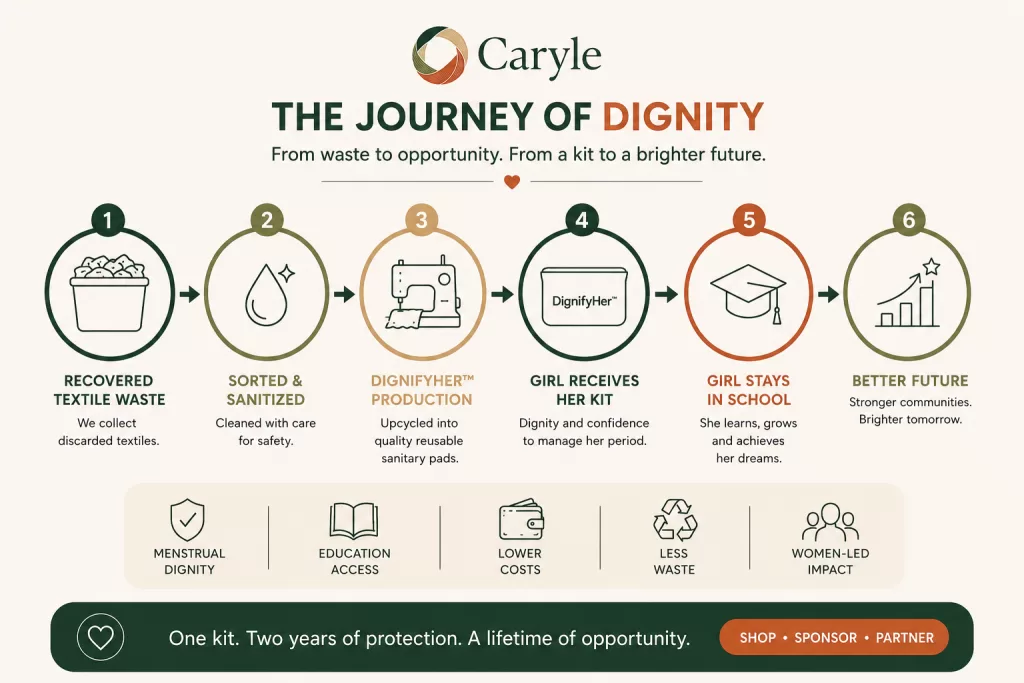
Through DignifyHer™ Reusable Sanitary Pads, recovered textile waste is transformed into high-quality reusable menstrual products. What would otherwise contribute to landfill waste becomes a solution that supports girls’ education, protects the environment, and creates employment opportunities for women and youth through circular economy production.
It is a simple yet powerful example of how one solution can address multiple social and environmental challenges simultaneously.
Providing reusable sanitary pads alone is not enough.
Girls also need accurate menstrual health information, supportive teachers, engaged parents, and communities that openly discuss menstruation without shame or stigma.
That is why Caryle integrates menstrual health education, product-use training, and awareness sessions into many of its community programmes.
When girls understand their bodies and have access to safe menstrual products, they gain confidence, remain active in school, and participate more fully in everyday life.
Ending period poverty requires collective action.
Governments, schools, NGOs, businesses, parents, development partners, and individuals all have a role to play.
Whether it is purchasing reusable sanitary kits, sponsoring girls from vulnerable households, supporting menstrual health programmes, or advocating for menstrual dignity, every action contributes to creating a future where no girl misses school because of her period.
Because menstrual dignity is not a privilege.
It is a fundamental part of ensuring every girl has an equal opportunity to learn, grow, and achieve her full potential.
Together, we can build communities where dignity, education, and sustainability go hand in hand.
Every DignifyHer™ Reusable Sanitary Pad Kit helps a girl stay in school, saves families money for up to two years, and gives discarded textile waste a new purpose. Whether you’re an individual, school, NGO, corporate, or government institution, you can help make menstrual dignity accessible to more girls.
….and be part of a future where no girl misses school because of her period.
#MenstrualDignity #PeriodPoverty #GirlsEducation #KeepGirlsInSchool #MenstrualHealth #ReusableSanitaryPads #DignifyHer #CircularEconomy #TextileUpcycling #ClimateAction #WomenEmpowerment #GenderEquality #SustainableDevelopment #SocialEnterprise #MadeInKenya #Caryle